

Anna Lake now carries an official invasive designation after field verification confirmed zebra mussels and starry stonewort. State-level sampling and lab analysis verified both organisms near public access and dock zones. This confirmation places the lake among monitored waterbodies with active aquatic invasive species pressure.
Zebra Mussels Verified in Anna Lake
Survey teams located live zebra mussels attached to hard surfaces in shallow zones. Sampling confirmed shell clusters on dock pilings and nearby rocks.
Observed characteristics
- Firm attachment to submerged structures
- Filter-feeding behavior that alters plankton levels
- Shell accumulation along nearshore areas
Their presence changes water clarity patterns and reduces food availability for native species that rely on microscopic organisms.
Starry Stonewort Detection and Spread Pattern
Starry stonewort, an invasive macroalgae, appeared during late-season vegetation surveys. Crews identified dense mats close to high-traffic access points.
Growth traits
- Thick, carpet-like formations on lake bottoms
- Bulbils that survive winter conditions
- Rapid lateral expansion across soft sediments
These mats crowd out native plants and restrict fish movement in shallow habitats.
How These Species Entered Anna Lake
Introduction followed pathways seen across Minnesota lakes. Human-assisted transfer remains the dominant cause.
Likely entry routes
- Boats and trailers arriving without cleaning
- Anchors and ropes carrying plant fragments
- Residual water in live wells
Even minimal residue allows invasive organisms to establish new colonies.
Areas Showing the Highest Activity
Monitoring teams reported concentrated activity around public access and frequently used shoreline sections.
High risk zones
- Boat launches
- Dock clusters
- Shallow bays with soft sediment
Traffic volume directly increases spread speed across connected sections of the lake.
Effects on Native Aquatic Life
Zebra mussels filter large volumes of water, shifting nutrient availability. Starry stonewort forms dense layers that block light penetration.
Changes observed
- Reduced native plant diversity
- Altered feeding patterns among fish
- Lower oxygen flow inside vegetation mats
Native species face habitat compression as invasive coverage expands.
Recreational and Shoreline Concerns
Recreation quality declines as invasive density rises. Thick vegetation tangles propellers and limits swimming areas.
User-related challenges
- Slower boating access
- Rough shoreline surfaces from shells
- Fishing structure loss in vegetated zones
Maintenance costs increase for docks and shoreline equipment.
Management Actions Taken After Confirmation
Following verification, authorities initiated containment and monitoring measures near discovery points.
Active measures
- Delineated treatment zones
- Enhanced inspection signage
- Follow-up vegetation surveys
Control focuses on slowing expansion rather than full removal.
Comparison of Confirmed Invasive Species
| Species | Primary Behavior | Main Spread Method | Control Difficulty |
|---|---|---|---|
| Zebra mussel | Heavy filtration | Boat hull transfer | High |
| Starry stonewort | Dense bottom mats | Fragment movement | High |
Both species resist elimination due to reproduction efficiency and survival adaptability.
Seasonal Behavior Patterns
Warmer water accelerates reproduction and fragment spread. Recreational traffic peaks during the same period.
Seasonal pressure points
- Late spring plant expansion
- Summer boat movement
- Early fall vegetation persistence
Cold periods slow growth but fail to remove established populations.
Monitoring and Reporting Structure
State and county agencies conduct repeat surveys using diver inspections and rake sampling.
Monitoring focus
- Expansion rate tracking
- New colony detection
- Treatment effectiveness
Public reports support faster response during early spread stages.
Community Responsibilities Around Anna Lake
Local users play a direct role in limiting further transfer.
Recommended actions
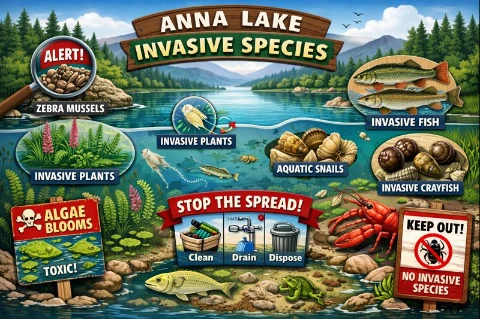
- Clean, drain, and dry boats after use
- Inspect anchors, ropes, and trailers
- Avoid transporting aquatic plants
- Follow posted access guidance
Consistent habits reduce cross-lake contamination risk.
Confirmed zebra mussel and starry stonewort presence signals long-term management demands. Climate shifts favor aggressive non-native growth, while native species adapt slowly.
Projected concerns
- Higher maintenance costs
- Reduced habitat quality
- Ongoing access limitations
Prevention remains the most effective defense against additional introductions.
Currently, Anna Lake holds verified zebra mussel as well as starry stonewort populations. Their establishment affects water quality, habitat structure, and recreational use. Regular monitoring, local cooperation, and strict prevention practices shape the primary response moving forward.