

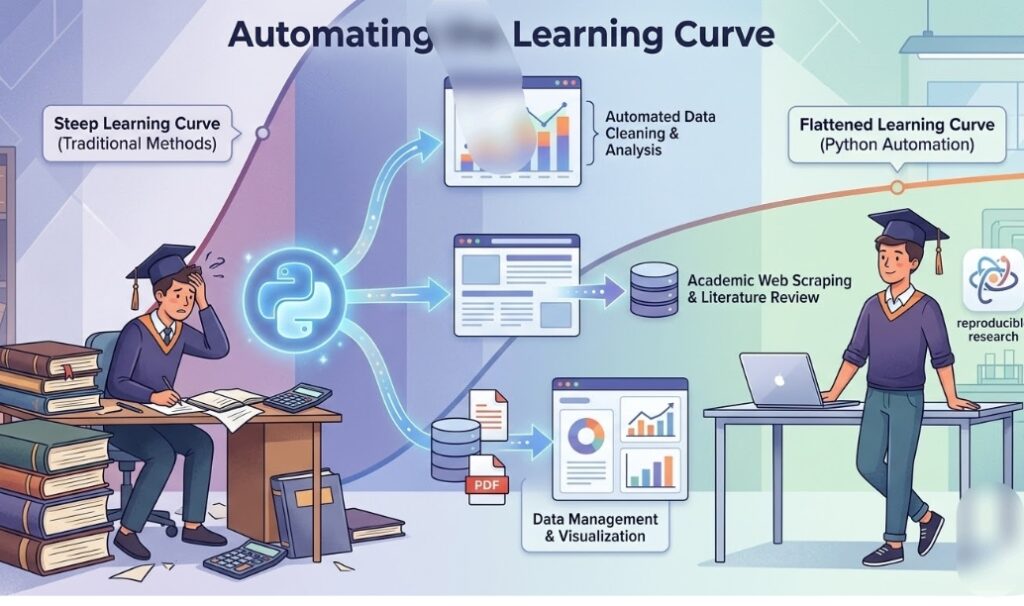
The modern academic landscape is no longer just about heavy textbooks and handwritten notes. As we move deeper into a data-driven era, students—especially those in STEM, economics, and social sciences—are finding themselves buried under a mountain of data processing, repetitive calculations, and complex simulations. Enter Python: the “Swiss Army Knife” of programming languages.
What was once a tool reserved for software engineers is now becoming a staple in the backpacks of college students worldwide. Python isn’t just for building apps; it’s for building efficiency. By automating the “learning curve,” students can spend less time on the grunt work of data entry and more time on high-level analysis and critical thinking.
The Shift from Manual to Automated Learning
For decades, the “learning curve” was a steep, often exhausting climb. If you were studying statistics, you spent hours plotting points by hand. If you were a biology major, you manually cross-referenced thousands of gene sequences. This manual labor was often mistaken for “learning,” but in reality, it was just a barrier to deeper understanding.
Python scripts have changed this dynamic. By writing a few lines of code, a student can automate the retrieval of research papers, scrape data from government websites, or run a simulation that tests thousands of variables in seconds. This shift allows students to focus on the why instead of the how.
However, transitioning from a traditional student to a “coding-literate” student isn’t always easy. While the logic of Python is intuitive, the syntax can be tricky. This is why many students seek out professional help with assignment tasks to ensure their initial scripts are built on a solid foundation of clean, functional code.
Why Python is the Language of Academics
There are hundreds of programming languages, but Python has won the academic race for three specific reasons:
- Readability: Python looks like English. For a 12th-grade student or a college freshman, reading a Python script is much easier than deciphering C++ or Java.
- The Ecosystem (Libraries): Python has “libraries” (pre-written code) for everything. Need to do calculus? Use SymPy. Need to analyze a CSV file with a million rows? Use Pandas. Need to visualize a black hole? Use Matplotlib.
- Community Support: Because so many researchers use it, if you run into an error, someone else has already solved it on a forum.
When a student learns to automate their workflow, they aren’t just finishing their homework faster; they are learning a professional skill that is highly sought after in the job market.
Practical Examples: Python in Action
1. Data Cleaning and Organization
Imagine you are writing a thesis on climate change and you have 50 different Excel files with weather data from different cities. Manually merging these would take days. A Python script using the Pandas library can merge, clean, and format that data in under five seconds.
2. Automating Citations and Bibliographies
One of the most tedious parts of academic writing is the bibliography. Python scripts can interface with APIs like Google Scholar to pull citation data automatically, ensuring that every comma and period is in the right place according to APA or MLA standards.
3. Solving Complex Mathematical Models
For engineering students, solving differential equations by hand is a rite of passage, but it’s also prone to human error. Python allows students to build models that visualize these equations. Seeing the curve of a bridge or the flow of electricity in a digital environment helps the concept “click” in a way that numbers on a page cannot.
For those diving into these technical depths for the first time, getting python programming assignment help can be a game-changer. It’s not just about getting the answer; it’s about seeing how an expert structures a script to solve a complex problem efficiently.
Overcoming the “Entry Barrier”
The biggest hurdle in academic automation is the “Fear of the Blank Screen.” Many students feel they aren’t “techy” enough to code. But the truth is, you don’t need to be a computer scientist to use Python. You just need to be a problem solver.
The best way to start is small. Don’t try to automate your entire degree in a day. Start by writing a script that renames a folder of 100 PDF files. Then, move on to a script that calculates your GPA. Once you see the power of automation in small tasks, the complex academic workflows start to look much less intimidating.
The Ethical Use of Automation in Education
A common concern among educators is whether automation is “cheating.” The answer lies in the intent. Using a script to scrape data for an original analysis is a sophisticated research method. Using a script to generate a fake essay is academic dishonesty.
Automation should be used to remove the drudgery, not the thinking. A student who uses Python to run a complex regression analysis still has to interpret what the “P-value” means and what the implications are for their field of study. Python provides the evidence; the student provides the insight.
Building a Future-Proof Skill Set
By the time most of today’s high school seniors graduate from college, the ability to interact with data via code will be as fundamental as the ability to use a word processor. By integrating Python into their academic workflows now, students are essentially “future-proofing” their careers.
Whether you end up in healthcare, law, or digital marketing, the ability to say “I can automate that” makes you an invaluable asset. It turns you from a consumer of information into a creator of systems.
Conclusion
Automating the learning curve is about reclaiming your time. In an age where information is infinite but time is strictly limited, Python serves as a bridge between curiosity and conclusion. It simplifies the complex, organizes the chaotic, and allows the human mind to do what it does best: innovate.
For those ready to take the leap into technical automation but feeling overwhelmed by the syntax, remember that expertise is a journey. Seeking out a python programming assignment help service or looking for general help with assignment platforms can provide the mentorship needed to turn a confusing script into a powerful tool.
Stop struggling with the manual climb. Start coding, start automating, and let your academic potential reach new heights.