

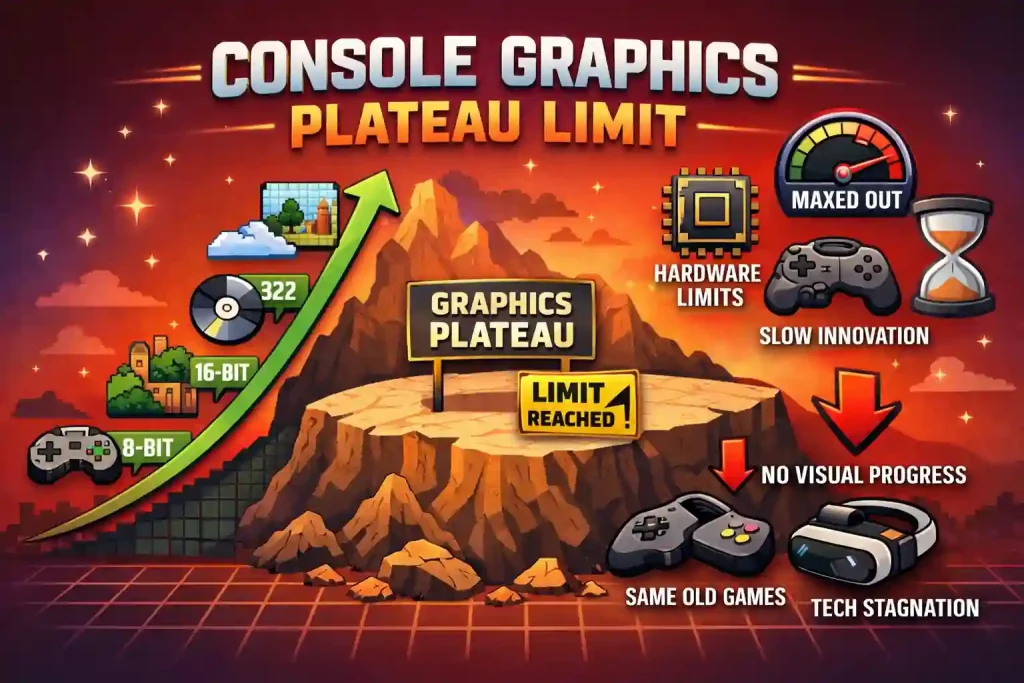
Console graphics have reached a phase where visible leaps feel smaller than earlier generations. Hardware power still improves, yet screen results appear familiar to many players. This shift marks the console graphics plateau limit, a stage shaped by technical ceilings, display technology, production realities, and player perception.
Earlier console eras delivered sharp visual jumps. Pixel art moved into 3D worlds, low-resolution textures transformed into detailed environments, and lighting systems became more realistic. Today’s consoles deliver refinement rather than dramatic visual change. The gap between promise and perception shapes ongoing debates across gaming communities.
The Nature of the Graphics Plateau
A graphics plateau does not signal stagnation. Hardware capability still expands. The challenge lies in human visual limits and diminishing returns.
Modern consoles already push:
- High-resolution textures
- Advanced lighting models
- Real-time reflections
- Complex particle effects
Each upgrade demands exponential processing power for incremental visual improvement. Early advances felt dramatic due to lower baselines. Current visuals already sit near realism, reducing perceived gains.
Hardware Constraints Shape Visual Progress
Console design balances power, cost, heat, and energy usage. Unlike high-end PCs, consoles target affordability for millions of users. This balance restricts extreme graphical experimentation.
Primary hardware factors:
- Thermal limits – compact designs restrict sustained performance
- Power budgets – living-room devices avoid extreme energy draw
- Fixed hardware lifespan – consoles remain unchanged for years
These limits encourage optimization rather than radical visual redesign.
Resolution Scaling Reaches Practical Limits
Resolution once served as a major selling point. The shift from 720p to 1080p felt dramatic. The move to 4K delivered clarity, yet benefits diminish beyond certain viewing distances.
Most living-room setups limit the visible difference between:
- Native 4K
- Upscaled 4K
- Advanced reconstruction techniques
As a result, developers prioritize stability and performance over raw pixel counts.
Lighting and Ray Tracing Trade-Offs
Real-time ray tracing promises realistic shadows, reflections, and global illumination. Console hardware supports limited ray tracing, though full implementation carries performance costs.
Compromises are:
- Reduced frame rates
- Selective ray-traced elements
- Hybrid lighting systems
These methods enhance realism subtly rather than redefining visuals outright.
Texture Quality vs Memory Budgets
Ultra-high-resolution textures demand massive memory allocation. Consoles operate under fixed memory pools shared across:
- Graphics
- Physics
- Audio
- AI systems
Developers balance texture sharpness with gameplay performance. The result prioritizes consistency over extreme detail.
Player Perception and Visual Saturation
Human perception adapts quickly. Once players adjust to high-quality visuals, improvements feel less noticeable.
Psychological factors are:
- Rapid normalization of realism
- Focus shifting toward gameplay mechanics
- Visual upgrades blending into expectations
This adaptation reinforces the feeling of a plateau, even amid technical progress.
Development Costs Limit Graphical Risk
Advanced visuals demand larger teams, longer timelines, and higher budgets. Studios face financial pressure to deliver stable returns.
High-risk visual experimentation may lead to:
- Performance instability
- Delayed releases
- Reduced gameplay scope
As a result, studios focus on polish, art direction, and optimization rather than raw graphical ambition.
Art Direction Outpaces Raw Fidelity
Visual style now matters more than polygon counts. Stylized games age better and avoid heavy performance demands.
Successful approaches:
- Distinct color palettes
- Stylized lighting
- Strong environmental identity
These techniques deliver memorable visuals without chasing photorealism.
Performance Targets Shape Visual Decisions
Frame rate expectations influence graphical limits. Many players prefer smooth performance over visual density.
Performance goals:
- 60 FPS for action titles
- Stable frame pacing
- Reduced input latency
Higher fidelity competes directly with these goals, reinforcing conservative visual choices.
Console vs PC Visual Differences
PC hardware advances faster due to modular upgrades. Consoles emphasize consistency and accessibility.
| Aspect | Consoles | PCs |
|---|---|---|
| Hardware upgrades | Fixed cycle | Continuous |
| Cost control | High priority | User-dependent |
| Optimization | Platform-specific | Hardware-dependent |
| Visual ceiling | Stable | Variable |
Why Graphics Marketing Feels Repetitive
Marketing language leans heavily on technical terms that deliver minimal visual distinction to average viewers.
Buzz phrases:
- Dynamic lighting
- Enhanced shadows
- Advanced reflections
These features improve realism incrementally rather than redefining experiences.
Gameplay Innovation Gains Priority
With graphics nearing saturation, innovation shifts toward systems, mechanics, and immersion.
Areas receiving greater focus:
- Physics-driven interaction
- Smarter NPC behavior
- Adaptive environments
- Player agency
These elements elevate experiences without relying on visual leaps.
Display Technology Sets Boundaries
Most players use televisions with standard refresh rates and HDR limitations. Console visuals adapt to mainstream displays rather than niche setups.
Constraints:
- Limited peak brightness
- Variable HDR quality
- Viewing distance reducing detail perception
Visual improvements beyond display capability remain unseen.
Optimization Over Raw Power
Modern development favors smarter resource usage rather than brute force rendering.
Optimization strategies:
- Temporal upscaling
- Variable rate shading
- Level-of-detail scaling
These methods maintain quality while controlling performance demands.
The Plateau Does Not Mean Stagnation
Progress still occurs, though subtly. Advances appear through refinement rather than revolution.
Ongoing improvements:
- Better animation blending
- More natural character movement
- Improved facial expression systems
- Enhanced environmental interaction
These upgrades feel organic rather than flashy.
Future Directions for Console Visuals
Rather than dramatic leaps, upcoming progress likely centers on:
- AI-assisted rendering
- Smarter upscaling techniques
- Procedural asset generation
- Enhanced immersion through sound and haptics
Visual realism will grow quietly alongside experiential depth.
Factors Behind the Graphics Plateau
| Effect on Visual Progress | |
|---|---|
| Hardware limits | Caps extreme fidelity |
| Human perception | Reduces noticeable gains |
| Development cost | Discourages risk |
| Display constraints | Hides ultra-fine detail |
| Performance goals | Limits visual density |
The console graphics plateau limit represents maturity rather than decline. Visuals approach realism while innovation shifts toward interaction, immersion, and performance stability. Future improvements will feel smoother, smarter, and more integrated into gameplay rather than instantly eye-catching.
Players may not witness dramatic leaps similar to past generations, yet gaming experiences continue evolving through refined technology and creative design choices.