

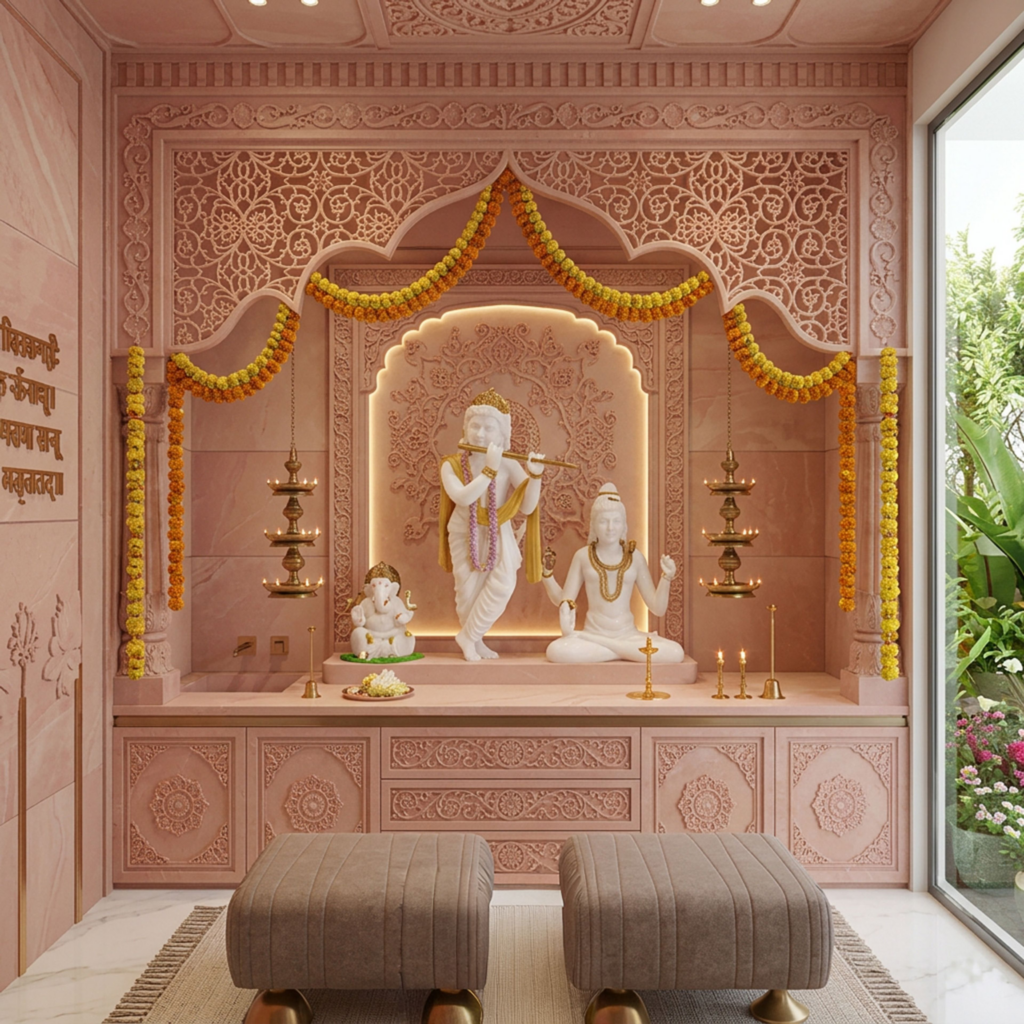
You spend weeks picking the right pooja temple for your home. You study each carving, compare panel sizes, and approve the finish with care. Then the lights come on, and the marble looks faintly yellow, or it turns flat and cold. Many owners blame the stone at that moment, when the bulb is usually the real cause.
That is why lighting deserves the same attention as the design itself. A white marble pooja temple for home responds to light in a way that wood and painted surfaces rarely do. Fine-grained marble lets a little light sink into its surface before it bounces back. So the same mandir can look soft and glowing at dusk, and perhaps slightly grey by morning.
What Warm and Cool Light Mean for a Marble Mandir
Bulb colour is measured in Kelvin, and the number is printed on every LED box.
- Warm white runs from about 2000K to 3000K and ranges from orange to yellow-white.
- Cool white sits between roughly 3100K and 4500K, giving a neutral tone that can lean slightly blue.
- Anything above 4500K moves into the daylight range.
It is tempting to shop by the words on the front of the pack. That habit causes trouble. “Warm white” from one brand can look quite different from another, so read the Kelvin figure instead.
How Warm Light Changes Vietnam White Marble
Warm light is what most families picture when they think of the evening aarti. It resembles the glow of a diya, and it softens the shadows inside deep carvings. Floral jaali work, bells, and toran details look gentler and more rounded.
Here is why some owners fall in love with it. Warm light makes the gold leaf on the murti look richer, and marigold garlands seem brighter against the stone. The whole corner feels calm, which suits a space meant for quiet prayer.
There is a catch, though. If you push the light toward the very bottom of the warm range, Super Fine White Vietnam Marble can start to read as cream or ivory. Some people like that look. Others feel they chose white stone and ended up with something that looks older than it is. Both reactions may be fair.
How Cool Light Changes a White Marble Pooja Temple
Cool light brings out the marble’s natural colour. The white of the Swiss White Marble looks clean, and fine carving lines stand out sharply. For intricate panels, that crispness has real appeal.
Go too far, and the mood changes. Bulbs rated 5000K to 6500K give off a crisp, blue-white light close to midday sun. At night, that can feel stark in a prayer space. The marble may even pick up a faint blue cast, and the room loses its warmth.
Cool light still has its place. It helps during morning puja, when you want the space to feel bright and awake. It also makes cleaning easier, since dust and oil marks show up clearly.
Why Colour Rendering Matters as Much as Kelvin
Kelvin tells you the light’s tone. It does not tell you how honestly that light shows colour. That job belongs to the Colour Rendering Index, or CRI.
Two 2700K bulbs can look equally warm, while the one with the higher CRI shows reds and greens far more faithfully. In a pooja temple, this matters more than people assume. Kumkum, flowers, silk vastra, and painted murtis all depend on true red and green tones. A low-CRI bulb can make fresh flowers look dull, and the stone look muddy. Where possible, pick bulbs with a CRI in the 90s.
Heat, Light and the Stone Surface
Heat is another question owners ask, and it is a fair one. LEDs give off very little heat, while incandescent bulbs lose about 90% of their energy as heat. LEDs also produce little infrared and almost no UV light, which is why they are considered safe near sensitive museum pieces.
That makes LED strips a sensible choice inside a canopy or behind a carved jaali. Diyas are another matter. An open flame placed too close to a panel can leave soot marks over time. Keep the lamp a few inches forward on the pedestal, and wipe the stone gently with a soft, dry cloth after long rituals.
Bottom Line
Is one setting right for every family? Probably not. A home with brass diyas and wooden furniture may lean warm, while a minimal apartment with white walls may suit a cooler tone. Still, the principle stays the same. Your marble can only look as good as the light that falls on it.
So before the final installation, ask yourself a simple question. How do you want your temple to feel when you light the lamp on a quiet evening?