

Vibration is one of the most destructive forces in mechanical systems. Over time, it does something engineers dread: it quietly loosens fasteners that hold critical assemblies together. Standard nuts are particularly vulnerable, and when they fail, the consequences range from expensive repairs to complete system breakdowns.
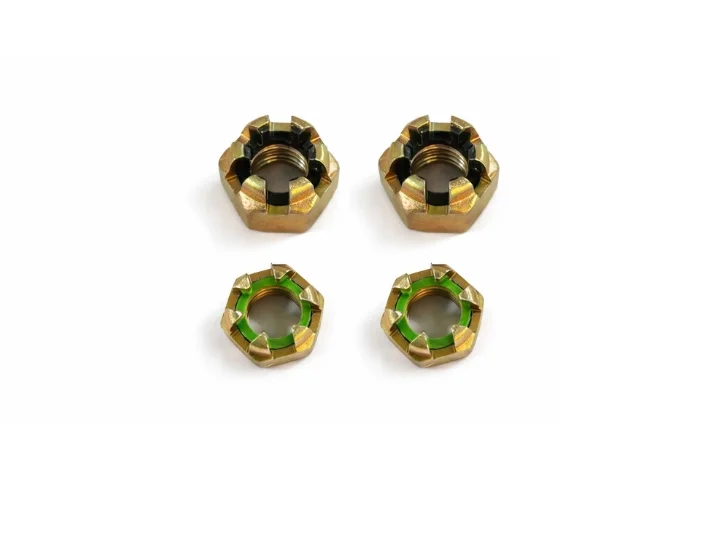
Castle Nuts offer a mechanical solution that standard hex nuts simply cannot match. Their slotted crown design, paired with a cotter pin threaded through a drilled bolt shaft, creates a physical barrier against rotation. This isn’t just about tightness; it’s about locking the assembly in place permanently until it is intentionally disassembled. Castle Nuts are widely used precisely because the locking mechanism is both simple and dependable under sustained vibration loads.
When Standard Nuts Simply Are Not Enough
The Hidden Cost of Gradual Loosening: A nut that loosens by even half a turn can shift load distribution across an entire joint. In rotating machinery or suspension components, that shift creates wear patterns that compound rapidly. Many mechanical failures traced back to fastener loosening began with a single overlooked nut that had been slowly backing out over hundreds of operating hours.
Why Vibration Defeats Conventional Locking: Standard nuts rely on friction and thread engagement to stay in place. Repeated vibration cycles gradually overcome that friction, especially when thermal expansion and contraction are also factors. Mechanical locking through physical retention, rather than friction alone, is what separates high-performance fastener solutions from standard ones in demanding applications.
The Mechanical Logic Behind the Castle Nut Design
How the Slotted Crown Works With a Cotter Pin: The crown of a castle nut features evenly spaced slots cut into the top. Once the nut is torqued to specification, a cotter pin is inserted through one of these slots and through a corresponding hole drilled into the bolt shank. The pin is then bent to secure it. This prevents any rotational movement in either direction, regardless of the vibration intensity the assembly experiences.
Precision in Installation Matters More Than Most Realise: Getting the cotter pin through the correct slot requires careful torque management. The nut must reach the right clamping force while aligning a slot with the bolt hole. Over-torquing to force alignment compromises joint integrity. Under-torquing leaves the joint weak. This is where precision-manufactured castle nuts make a real difference; their dimensional accuracy ensures consistent slot positioning relative to standard torque values.
Applications Where Failure Is Not an Option
Castle nuts are used across critical industries for good reason:
- Automotive wheel hub assemblies where bearing preload must remain constant under cornering forces and road vibration.
- Suspension tie rod ends and ball joints where any loosening creates dangerous steering instability.
- Aircraft control linkages where regulatory standards demand mechanical retention over friction-based solutions.
- Heavy construction equipment pivot points that experience severe shock loading during operation.
- Marine propeller shaft assemblies where water resistance and vibration combine to challenge standard fasteners.
Automotive Suspension Systems and Load Dynamics: In suspension systems, castle nuts are fitted at points where the fastener is subject to both rotational stress and directional load changes. A wheel bearing nut that loosens even slightly causes bearing play, which accelerates wear exponentially. Replacing a bearing assembly because of a loose nut is an expensive lesson that many fleet operators have learned the hard way. The castle nut eliminates that risk with a straightforward mechanical principle.
Precision Engineering and Long-Term Reliability
Why Material and Manufacturing Quality Change Everything: A castle nut is only as reliable as its manufacturing precision. Slots that are inconsistently cut, crowns that are not perfectly dimensioned, or threads that do not hold tolerance all undermine the locking mechanism. Thread tolerance is a specification that often gets overlooked when purchasing fasteners, yet it directly determines how well the nut engages the bolt and how consistently the cotter pin aligns during installation.
Durability Under Thermal and Mechanical Stress: Engines and heavy machinery operate through significant temperature ranges. Thermal cycling causes materials to expand and contract, which puts additional stress on fastener joints. Castle nuts manufactured from the correct grade of steel, with appropriate surface treatment, maintain their dimensional stability across these temperature ranges. That consistency is what keeps the cotter pin seated and the joint locked even after thousands of operating cycles.
Long-Term Cost Reduction Through Reliable Fastening: Unplanned downtime is expensive regardless of the industry. A single fastener failure in a critical assembly can halt an entire production line, ground a vehicle fleet, or trigger a safety review that costs more than the machinery itself. Using precision castle nuts in the right applications is, perhaps, one of the more straightforward ways to reduce maintenance intervals and avoid the repair costs that follow fastener-related failures.
Building Systems That Stay Tight When It Matters
Choosing the right fastener for high-vibration environments is not a minor detail; it is a decision that affects operational safety, maintenance budgets, and long-term reliability. Castle nuts, when correctly specified and installed, provide the kind of mechanical retention that standard nuts cannot offer. If your assemblies operate under sustained vibration, explore precision-engineered castle nut solutions that are built to hold under the conditions your machinery actually faces.