

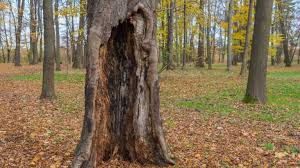
A tree can look stable from the curb and still be losing strength from the inside. That mismatch is what makes internal decay such a costly risk for property managers who rely solely on appearance.
By the time a trunk cavity becomes obvious or a major limb fails, the warning period has usually passed. Early internal decay is often detectable long before a tree becomes an emergency, but it takes disciplined inspection and pattern recognition to catch it. Tree service teams evaluate structure, growth response, bark condition, root-zone clues, and stress history to determine whether a tree is simply aging or quietly losing internal support.
How Internal Decay Hides Behind Green Canopies
- Why Internal Decay Gets Missed
Internal decay is easy to miss because trees are built to hide stress. They can continue leafing out, casting shade, and looking full while internal wood quality declines. In commercial landscapes, this creates a false sense of security, especially when the canopy still appears green and the trunk looks intact from a distance.
Property teams often focus on obvious signs such as dead limbs or storm damage, but decay frequently begins in less dramatic ways. A past pruning wound, old branch tear, trunk injury, or repeated moisture exposure can create an entry point for decay organisms years before visible collapse risk is discussed. The practical issue is not whether a tree looks alive. It is whether its internal structure is still reliable.
- Reading Wounds And Old Damage
Tree services often begin by reviewing the tree’s damage history. Old pruning cuts, storm scars, mower injuries, vehicle impacts, and construction damage can all create pathways for decay. Not every wound leads to structural decline, but wound location, size, and closure pattern help crews estimate the likelihood of internal deterioration.
This is where experienced local crews, such as Sindt Tree Service of Auburn, are often called in early on larger properties, because repeated site exposure helps them recognize which wounds are aging normally and which are associated with internal weakness patterns. A wound that never sealed properly, shows bark separation, or sits near a major union deserves closer attention, even if the tree still has a healthy-looking canopy.
- Bark Changes That Signal Trouble
Bark condition can provide useful clues about hidden decay. Tree services look for cracking patterns, loose bark sections, sunken areas, seams, and places where bark appears to be sloughing off without a clear external cause. These changes may indicate internal wood breakdown, dead tissue beneath the bark, or structural stress that is altering the trunk surface.
A key point for property managers is that bark symptoms are often localized. One side of the trunk may appear normal, while the other shows subtle changes that suggest internal deterioration. That is why quick walk-by checks can miss early warning signs. Inspectors typically move around the entire tree, checking trunk flare, root collar, and scaffold branch attachments where hidden decay can affect load-bearing strength.
- Fungal Growth Near Trunk Base
Fungal fruiting bodies around the trunk base, root flare, or major branch unions are among the strongest visible indicators that decay may be active inside the tree. A mushroom or conk does not always indicate an immediate failure risk, but it does mean that wood decomposition should be taken seriously. The type, location, and recurrence of fungal growth help tree services judge the likely extent and significance.
For commercial and multi-building properties, recurring fungal growth is especially important because it is often treated as a cleanup issue instead of a structural one. Removing visible fungi without evaluating the tree condition does not address what may be happening internally. Tree crews document where the growth appears and whether it is associated with wounds, cavities, or root-zone decline patterns.
- Cavities And Hollow Sound Clues
Visible cavities are an obvious sign of decay, but tree services are also trained to detect less visible hollows. During inspection, they may use sounding techniques to compare how different sections of the trunk respond. Changes in sound can suggest voids or decayed wood behind what still appears to be a solid exterior shell.
This does not mean every hollow-sounding area creates an immediate hazard, because trees can sometimes retain enough sound wood to remain stable for a period. The practical value is early identification. If internal voids are suspected, the tree can be monitored more closely, load-reduced through pruning, or evaluated further before a storm or high-use season increases risk to people, vehicles, or structures nearby.
- Crown Symptoms That Reflect Structural Stress
Canopy condition can also reveal internal problems, especially when decline appears uneven or out of proportion to seasonal conditions. Tree services look for dieback in specific scaffold limbs, sparse leafing on one side, unusually small leaves, or premature leaf drop that do not match those of nearby trees of the same type. These symptoms may indicate compromised vascular flow or structural decay in part of the tree.
Property teams sometimes assume all crown thinning is a watering or fertilization issue. Sometimes it is. But when canopy decline aligns with trunk wounds, fungal growth, or bark changes, internal decay becomes more likely. Good tree assessments connect crown symptoms to trunk and root observations rather than treating each symptom as a separate landscaping problem.
Early Inspection Protects Trees And Property
Tree services identify early internal decay by combining visual evidence, damage history, structural inspection, root-zone assessment, and targeted diagnostics when needed. They are not just checking whether a tree is alive. They are evaluating whether it remains structurally sound in the context of nearby people, buildings, and daily site use.
For property managers and building owners, the advantage of early evaluation is straightforward. It improves planning, reduces emergency removals, and supports safer landscape decisions before visible failure signs appear. Trees can remain valuable site assets for years, but only when hidden structural decline is recognized in time. Internal decay rarely starts as an emergency. It becomes one when early clues are missed.