

Construction is one of the most coordination-intensive industries in existence. A commercial construction project involves dozens of subcontractors, hundreds of workers, a project management team, an engineering team, an architect, a client, and a regulatory authority, all of whom need to be synchronized around a schedule that changes daily as conditions on the ground evolve. The coordination failures that produce construction delays, cost overruns, and safety incidents are almost never caused by a lack of expertise or a lack of effort. They are caused by information that did not reach the right person in time, approvals that sat in someone’s inbox while a work crew waited, and changes that were communicated to one team and not the others who needed to know. The construction industry’s coordination problem is a general operational infrastructure problem wearing a hard hat. The contractors and developers that deliver projects on time and on budget consistently are not the ones with better engineers or better subcontractors. They are the ones that have built a coordination infrastructure on project management tools designed for the pace, the complexity, and the distributed nature of construction coordination.
A single source of truth for project status across all trades with Lark Base
Construction project status is managed through a combination of site walks, daily reports, and weekly coordination meetings in most organizations. By the time the status information from any of these mechanisms reaches the project manager, it is between one and seven days old, and the decisions made on its basis are made on a lagging picture of a project that changes daily.
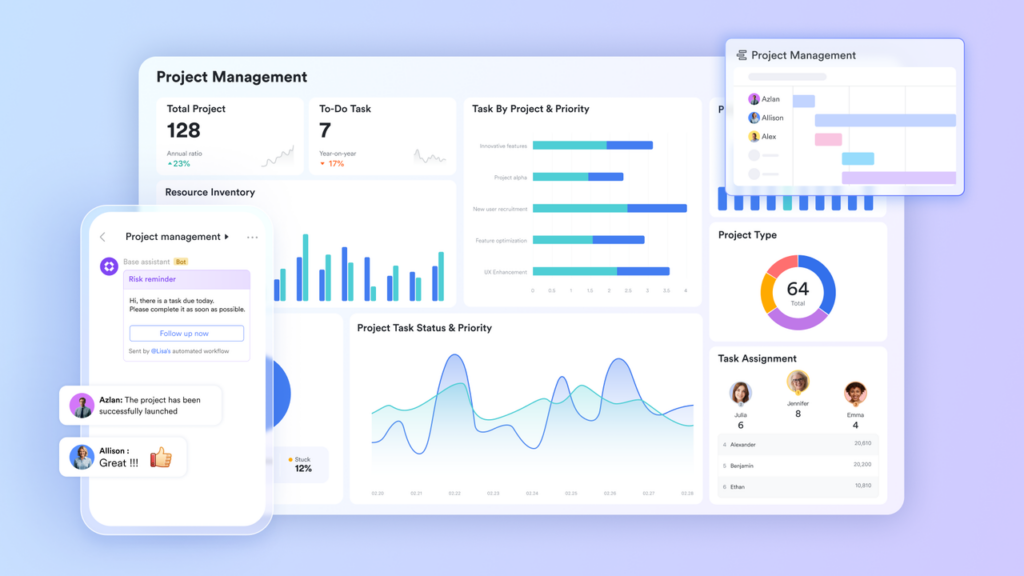
- Shared Kanban and Gantt views give every member of the project team, from the project manager to the site supervisor, a live view of every trade’s current progress against the schedule without requiring a physical site walk or a coordination meeting to establish the current state.
- Automated notifications trigger when a task changes status, when a milestone is approaching without the preceding task being complete, and when a subcontractor has logged a delay, so the project manager receives targeted alerts rather than having to proactively gather information through coordination meetings.
- Shared dashboards give the client and the developer a live view of overall project progress, trade-specific status, and cost tracking without requiring the project manager to prepare a separate client report for every progress review meeting.
Structured site reporting that replaces the email photograph with Lark Forms
The daily site report that arrives as an email with a paragraph of text and three attached photographs is a site report that the project management team has to read, interpret, and manually enter into the project tracking system. The construction industry has thousands of project teams performing that manual translation step every day, and the cost is paid both in the time of the people performing it and in the information loss that the translation introduces.
- Conditional form logic for trade-specific daily reporting ensures that every trade’s daily report captures the specific information relevant to their work scope, including progress percentage, workforce count, materials received, and issues encountered, in a structured format rather than an unstructured narrative.
- Direct Base mapping means every daily report lands as a structured record in the project management team’s operational database the moment it is submitted, so the project status is always current without a manual translation step.
- Photo and attachment fields allow site supervisors to include visual documentation of progress and issues within the structured report rather than as separate email attachments, keeping all the documentation for any given day in a single searchable record.
Trade coordination without the coordination meeting with Lark Messenger
Construction site coordination meetings exist to ensure that the trades working in the same space on the same day are aware of each other’s schedules, requirements, and constraints. They are time-intensive, frequently ineffective at communicating the information they are called to share, and usually scheduled on a cadence that does not match the pace at which coordination needs change on a live construction site.
- Lark allows administrators to create user groups and dynamic groups that can be organized around specific trades, subcontractors, or disciplines, helping project teams keep communication more focused. While this does not include folder-based chat organization, it helps project managers coordinate with different stakeholders without relying on a single crowded communication channel.
- “Real-time Auto Translation” across 24 languages supports the multilingual workforce that characterizes most major construction projects, allowing the project management team to communicate safety instructions, schedule changes, and coordination requirements to every trade in the language they work in.
- “Scheduled Messages” allow the project management team to push daily coordination briefings to every trade at the start of the working day, ensuring that schedule changes and site coordination requirements reach every subcontractor simultaneously rather than being communicated sequentially through morning phone calls.
Change order approvals that do not delay the work with Lark Approval
Change orders are the primary source of construction project delays and disputes. A change is identified on site. The change order is drafted. It sits in the client’s inbox. The trade that needs the authorization to proceed cannot get it. The crew stands down. The schedule slips. By the time the change order is approved, the delay has become an extension claim.
- “Parallel Routing” sends change order approvals to all required reviewers, including the client, the architect, and the developer’s project manager, simultaneously rather than sequentially, so the total approval time reflects the pace of the slowest single reviewer rather than the sum of every reviewer waiting in sequence.
- “Conditional Branches” route change orders automatically based on their value, scope, and impact category, so minor scope clarifications are approved at the subcontractor manager level without requiring client involvement, and major scope changes are escalated appropriately without manual direction.
- Full approval history provides a comprehensive, timestamped record of every change order decision that satisfies contract administration requirements and provides the documentary foundation for dispute resolution without requiring the project management team to maintain a separate change order log.
Compliance documentation that builds itself with Lark Docs
Construction compliance documentation, inspection records, safety reports, certifications, and regulatory submissions, represents a significant administrative burden that consumes project management time that should be spent on project coordination. The documentation that has to be assembled, formatted, and submitted manually is documentation that somebody has to spend billable time producing.
- Document templates for every recurring compliance document type, daily safety inspection records, subcontractor certifications, and progress reports, ensure that the documentation standards required for contract compliance are met consistently without requiring the project team to recreate the format for each submission.
- Real-time co-editing allows the project management team, the site supervisors, and the safety officers to contribute to compliance documentation simultaneously rather than passing a single document sequentially, reducing the time between the event that generates the documentation requirement and the completion of the document.
- “Version History” records document changes with editor names and timestamps, helping teams track how compliance documents evolve over time. Users with edit permissions can review previous versions when needed, which supports audit preparation and document traceability. However, changes made within certain embedded blocks, such as calendar events, are not included in version records.
Bonus: Why construction coordination problems persist despite industry investment
The construction industry has invested significantly in construction-specific technology, project management software, BIM platforms, and scheduling tools, without resolving the fundamental coordination problem because that problem is a general communication and information flow problem rather than a construction-specific technical problem. Procore and PlanGrid improve the project management layer. Autodesk handles the design and BIM layer. But neither provides the communication, the approval workflow, or the general operational coordination layer that construction project coordination requires.
Construction firms evaluating Google Workspace pricing for general collaboration often find that they still need additional project management tools for field operations. This can create a split system where construction-specific workflows live in one platform while communication, approvals, reporting, and documentation are handled elsewhere. Lark brings communication, approval workflows, daily reporting, and compliance documentation into one operational environment that supports both project managers in the site office and subcontractor supervisors in the field.
Conclusion
The construction site coordination problem is solved not by better construction-specific technology but by better general operational infrastructure that is robust enough to handle the distributed, real-time coordination demands of a live construction project. A connected set of productivity tools that keeps project status current, makes site reporting structured, coordinates trades without coordination meetings, accelerates change order approvals, and builds compliance documentation as a byproduct of daily operations is how construction organizations deliver projects on time and on budget consistently rather than occasionally.