

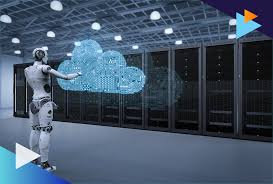
AI workloads push data centers far beyond the demands of traditional enterprise computing. Training clusters, inference platforms, and accelerated storage systems generate intense heat, draw large amounts of power, and create traffic patterns that can overwhelm older facility designs. A standard rack layout that once handled conventional servers may struggle when dense GPU systems are placed side by side and expected to run continuously. That is why AI data centers are built and managed differently. Efficiency at this scale depends on coordinated control of cooling, power delivery, rack design, airflow, and monitoring, so that high-density compute can operate reliably without generating waste or instability.
What Keeps Density Stable
- Designing Around Heat and Power Demand
AI data centers handle high-density compute loads efficiently by treating heat and power as core design constraints rather than secondary mechanical concerns. Dense compute clusters create concentrated thermal output that cannot be managed well with the same room-level strategies used in lower-density environments. Operators start by arranging racks, containment systems, and cooling paths so hot exhaust does not mix freely with incoming cold air. Cold aisle and hot aisle separation, rear-door heat removal, and direct liquid-based solutions are often evaluated based on the amount of heat a given rack generates under sustained load. Power distribution is planned just as carefully. High-density environments require electrical systems that can support peak demand without causing instability at the rack or row level. That includes redundancy planning, busway configuration, power quality control, and capacity modeling that reflects real AI workloads rather than average office-style server use. The facility is not simply sized for today’s deployment but for how density may increase as hardware generations change. Efficiency improves when cooling and electrical infrastructure are aligned with actual compute behavior, rather than being forced to react after problems arise. In AI environments, design discipline matters because once density climbs, even small mismatches between thermal load and facility support can lead to wasted energy, reduced hardware performance, or limits on future expansion.
- Matching Cooling Strategy to Compute Intensity
Cooling efficiency in AI data centers depends on removing heat close to where it is produced, while avoiding overcooling the rest of the room. High-density compute loads generate far more concentrated heat than many legacy spaces were designed to manage, so operators use targeted cooling methods rather than relying only on broad ambient temperature control. Liquid cooling, direct-to-chip systems, high-capacity rear-door exchangers, and tightly managed airflow paths allow facilities to handle dense clusters more effectively than a purely room-based approach. Even when air cooling remains part of the system, it is usually supported by containment and pressure control so that cooling capacity reaches the racks that need it most. Many operators also tune setpoints and flow behavior according to actual workload intensity rather than leaving systems fixed at conservative settings around the clock. In discussions about dense thermal management, phrases like AI data center cooling by WesTech often reflect the broader idea that cooling has become a dedicated engineering problem rather than a background utility. What matters most is not simply adding more cooling capacity, but matching the method of heat removal to rack density, equipment layout, and the way workloads fluctuate over time. This targeted approach reduces waste while protecting performance during sustained compute demand.
- Using Monitoring and Load Distribution Intelligently
Efficient handling of high-density compute also depends on visibility. AI data centers rely on monitoring systems that track temperature, power usage, airflow behavior, rack utilization, and equipment response in near real time. Without that level of awareness, operators may not notice developing hotspots, uneven loading, or inefficient cooling behavior until performance begins to drop. Monitoring allows teams to see whether one cluster is drawing disproportionate power, whether cooling delivery is uneven across a row, or whether certain workloads should be shifted to protect thermal stability. Load distribution becomes an important operational tool because efficiency is not determined by hardware alone. It is shaped by how jobs are scheduled, where computing is concentrated, and whether facility limits are being approached in specific zones. Some AI tasks can run continuously at high utilization for long periods, meaning the data center must manage not only peak conditions but also sustained stress. Operators use telemetry and infrastructure management tools to align compute demand with facility performance, keeping the environment balanced. This helps reduce localized strain, maintain more predictable temperatures, and use cooling and electrical capacity more effectively. In high-density environments, efficient operation is not static. It is the result of constant adjustment informed by what the facility is doing moment by moment.
Why Coordination Determines Efficiency
AI data centers handle high-density compute loads efficiently because they are designed as coordinated systems rather than collections of independent hardware. Dense racks, high electrical demand, and intense thermal output require cooling, power delivery, monitoring, and workload management to operate in concert. When one part of that system is underplanned, the entire environment becomes harder to scale and more expensive to operate. When those parts are aligned, facilities can support demanding AI workloads with more stability and less waste. Efficiency in this setting is not just about lowering energy use. It is about sustaining performance, protecting infrastructure, and making high-density compute practical at scale.