
In the rapidly evolving landscape of modern communication, two-way radios remain indispensable tools across a wide range of sectors in Mexico, from public safety and logistics to mining and construction. Their reliability, robustness, and ability to operate in environments where other technologies fail make them the backbone of critical operations. However, choosing the right radiocommunication equipment can be a challenge, given the diversity of types, brands, and technologies available. This exhaustive guide is designed to help professionals and enthusiasts navigate the Mexican market, highlighting key features, specific applications, and technological innovations that define today’s radiocommunication. We will explore market-leading options, including portable, mobile, marine, aerial, and intrinsically safe radios, as well as essential repeaters and accessories, with a focus on renowned brands such as Kenwood, ICOM, and Motorola.
Why Radiocommunication Remains Crucial in Mexico
Despite the rise of mobile phones and internet-based communications, two-way radios offer unique advantages that make them irreplaceable in many situations:
- Reliability in Hostile Environments: They operate in areas without cellular coverage, such as rural areas, mountains, or inside large metal structures.
- Instant One-to-Many Communication: They allow simultaneous communication with a group of people at the push of a button, ideal for work teams.
- Durability and Resistance: Designed to withstand shocks, dust, water, and extreme temperatures—essential features for industrial and outdoor use.
- Security and Privacy: They offer encryption options and dedicated frequencies that guarantee secure communications, crucial for public safety and businesses.
- Cost-Effectiveness: In the long run, radio systems can be more economical than cellular-based solutions for team communication.
Types of Radiocommunication Systems and Their Applications
The market offers a variety of radios, each designed to meet specific needs. Knowing the differences is fundamental to a successful choice.
1. Portable Radios (Handhelds)
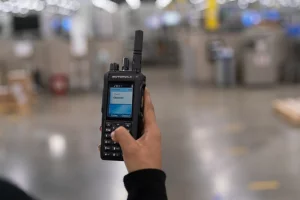
Portable radios are compact, lightweight, and easy to carry, ideal for workers who need to communicate while moving. They are widely used in:
- Security: Guards, police, event staff.
- Construction: Coordination on-site.
- Commerce: Retail staff, hotels, restaurants.
- Recreation: Hiking, camping, outdoor sports.
Key Features: Resistance to drops, water, and dust (IP certifications), battery life, and ease of use. Brands like Kenwood and Motorola offer robust models such as the Kenwood TK-3000-KV2 or the Motorola CP200d.
2. Mobile Radios
Designed to be installed in vehicles (cars, trucks, buses), mobile radios offer higher transmission and reception power, which translates to a greater range. They are essential for:
- Transport and Logistics: Vehicle fleets, taxis, delivery services.
- Emergency Services: Ambulances, fire trucks, patrol cars.
- Agriculture: Coordination over large areas of land.
Key Features: High output power (up to 50W), external antennas for greater range, and powerful speakers for noisy environments. ICOM and Kenwood are leaders in this segment with models like the ICOM IC-F5021 or the Kenwood TK-7360HV.
3. Marine Radios
Specifically designed for aquatic environments, these radios are waterproof and corrosion-resistant. They are vital for:
- Navigation: Fishing boats, yachts, commercial vessels.
- Maritime Rescue: Coast Guard, salvage teams.
Key Features: Waterproof certification (IPX7 or higher), Digital Selective Calling (DSC) functions for emergencies, and access to weather channels. ICOM is a benchmark with its IC-M series.
4. Aviation Radios
Used in aircraft and by ground personnel at airports, these radios operate on specific aviation frequencies and are crucial for air safety.
- General Aviation: Small plane pilots, helicopters.
- Air Traffic Control: Communication between pilots and control towers.
Key Features: AM frequencies, noise cancellation, and emergency functions. ICOM also offers robust solutions for this sector.
5. Intrinsically Safe Radios
These radios are designed to operate safely in hazardous environments where there are flammable gases, vapors, or combustible dust (ATEX zones). They are mandatory in:
- Oil and Gas Industry: Platforms, refineries.
- Mining: Underground mines.
- Chemical Industry: Processing plants.
Key Features: Safety certifications (FM, ATEX, UL), sealed construction to prevent sparks. Motorola and Kenwood have a strong presence in this niche with models like the Motorola XPR 7550 IS.
Repeaters and Accessories: Extending Range and Functionality
To maximize the efficiency of a radiocommunication system, repeaters and a variety of accessories are essential.
Repeaters
A repeater is a device that receives a radio signal, amplifies it, and retransmits it, significantly extending the communication range. They are fundamental for:
- Large Geographical Areas: Coverage in large cities, mountainous areas, or extensive properties.
- Tall Buildings: Signal penetration in complex structures.
Key Features: Output power, channel capacity, and compatibility with analog and digital systems. Brands like Kenwood and Motorola offer high-performance repeaters.
Essential Accessories
Accessories improve the functionality, comfort, and durability of radios:
- Long-Life Batteries: Crucial for long shifts or intensive use.
- Multi-Chargers: To charge several radios simultaneously.
- Headsets and Microphones (Hands-Free): Allow discreet and efficient communication in noisy environments or when hands-free operation is needed.
- Antennas: Higher gain antennas for mobile radios or replacement antennas for portables.
- Cases and Clips: Protect the radio and facilitate its transport.
Technological Advancements in Radiocommunication
Radiocommunication technology has evolved considerably, now offering advanced features that improve efficiency and security.
1. Digital Radios (DMR, NXDN, P25)
Digital radios offer superior audio quality, greater spectral efficiency (more users in the same bandwidth), and advanced functions such as:
- Text Messaging: Sending short messages.
- Integrated GPS: Tracking personnel location.
- Encryption: Greater security in communications.
- Data Applications: Integration with management systems.
2. PoC (Push-to-Talk over Cellular) Radios
These radios combine the immediacy of PTT with the wide coverage of cellular networks (LTE/4G/5G). They are ideal for teams operating in large geographical areas with good cellular coverage, eliminating the need for their own repeater infrastructure. Brands like Hytera and Txpro offer PoC solutions.
3. Integration with Other Systems
Modern radiocommunication systems can be integrated with security systems, access control, and fleet management, creating unified communication ecosystems.
How to Choose the Right Provider in Mexico
Choosing a reliable provider is as important as selecting the equipment. A good provider doesn’t just sell radios; they offer advice, technical support, and after-sales service.
Key Criteria for Selection:
- Experience and Reputation: Look for providers with years of experience and good references in the Mexican market.
- Product Portfolio: Ensure they offer a wide range of products from leading brands (Kenwood, ICOM, Motorola) to cover all your needs.
- Technical Support and Warranty: Good technical service and solid warranties are crucial for the long-term investment.
- Specialized Advice: The provider should be able to understand your specific needs and recommend the most suitable solution.
- Offers and Promotions: Stay tuned for special offers and packages that can provide greater value. For a robust selection and competitive offers in the Mexican market, RadioRed stands out as a radiocommunication specialist, offering products from top brands and customer service focused on professional needs.
Frequently Asked Questions (FAQs) about Radios
Q1: What is the difference between an analog and a digital radio? A1: Analog radios transmit voice waves directly, while digital ones convert voice into data. Digital radios offer better audio quality at the edge of the range, greater spectral efficiency, and advanced functions like encryption and text messaging.
Q2: Do I need a license to operate radios in Mexico? A2: Yes, in Mexico, operating radios in most frequency bands requires a concession or permission for the use of the radio spectrum, granted by the Federal Telecommunications Institute (IFT). It is crucial to consult with an expert or the provider to ensure regulatory compliance.
Q3: What does the IP certification on a radio mean? A3: The IP (Ingress Protection) certification indicates the level of protection of a device against the entry of solids (dust) and liquids (water). For example, IP54 means protection against limited dust and water splashes, while IP67 indicates total protection against dust and temporary immersion in water.
Q4: Can I use my radio anywhere in Mexico? A4: It depends on the type of radio and the frequencies it uses. Radios with specific licenses are restricted to authorized areas and conditions. Free-use radios have a limited range and do not require a license, but their use is regulated.
Q5: How can I extend the range of my portable radios? A5: The most effective way to extend range is by using a repeater. Mobile radios with higher power and external antennas can also be used, or consider PoC systems if there is good cellular coverage in the operating area.
Q6: Which brands are most recommended for professional use in Mexico? A6: In Mexico, brands like Kenwood, ICOM, and Motorola are highly recognized and recommended for their quality, durability, and technical support. They offer a wide range of products for various applications and budgets.
Conclusion
Choosing the right radiocommunication system is a strategic decision that directly impacts operational efficiency and safety for any organization in Mexico. By understanding the different types of radios, their applications, technological advancements, and the importance of a reliable provider, businesses can make informed decisions that optimize their communications. From the robustness of a Kenwood portable radio to the range of an ICOM mobile system or the intrinsic safety of a Motorola, today’s technology offers solutions for every need. Investing in quality equipment and having the support of specialists guarantees smooth and secure communication, fundamental for success in the demanding Mexican environment. This strategic approach not only improves efficiency but also protects personnel and assets, ensuring every message reaches its destination, regardless of the conditions. Effective communication is, ultimately, the key to keeping operations running and responding effectively to any challenge.