

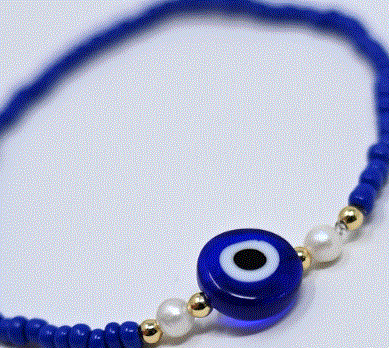
You’ve probably scrolled past one of those chakra charts: seven colored circles, a stone sitting next to each. Amethyst at the top. Rose quartz in the middle, darker stones down near the bottom. What the chart almost never tells you is where this framework came from in the first place, or why the stone lists you find don’t agree with each other.
Which is part of why a search for crystals shop near me will turn up chakra categories sitting right alongside individual stones. The category does the work of narrowing things down. After that, color and texture and shape, plus whatever intention you want the piece to stand for, tend to decide it.
All of this matters when you’re picking a crystal by intention. A chakra chart is a reasonable starting point. It isn’t a medical diagram, and it isn’t a fixed shopping rule either. What it is is one piece of a spiritual tradition that people have interpreted, illustrated and reworked for a very long time.
Choosing a Stone by Chakra
When a display case holds forty stones and you can’t take them all in, chakra shopping gives you somewhere to stand. Say heart-focused intentions are what pull at you: rose quartz or the green stones are the obvious place to look. Someone curious about root-chakra traditions might pick up red jasper first, or smoky quartz, or something black.
Try asking yourself this: “What do I want this stone to remind me to notice?” The question keeps the decision yours. It also stops you asking a bracelet or a pocket stone or a power vial to promise more than any spiritual object can.
Where the Framework Comes From
The chakra system wasn’t invented by crystal shops. It comes out of a long body of yogic and philosophical traditions from India, where chakras get described as centers within the subtle body, which is a spiritual model and not a structure you’d find in medical anatomy.
And the history runs wider than any one belief system or neat explanation. A Smithsonian exhibition on yoga’s visual history covered more than 2,000 years of yoga across Jain, Buddhist, Hindu and Sufi traditions. Once you know that, it’s easier to see why a short chart on a website can’t hold the whole thing.
Hold on to that history the next time a modern chart hands you every detail as though it were settled. Yes, the seven-chakra layout everybody recognizes is a widely used way into the tradition today. The longer record behind it takes in many texts, images, practices and interpretations.
Why Stone Lists Don’t Match
The correspondences are where shoppers usually get tangled up. You’ll see amethyst put with the crown chakra, lapis lazuli with the throat or sometimes the third eye, rose quartz with the heart, citrine with the solar plexus, carnelian with the sacral chakra, red jasper or black stones with the root.
Those pairings get repeated constantly in present-day crystal and spiritual retail traditions. But they don’t trace back to one dated original stone list, and that’s exactly why one chart puts turquoise at the throat while the next one reaches for sodalite, or aquamarine, or lapis lazuli instead.
Color does a lot of the steering here. Blue stones show up with throat-focused intentions, green and pink with heart-focused ones, red or black with the root. The pattern is genuinely useful for comparing what’s in front of you. It doesn’t mean your choice is wrong because some other shop prints a different chart.
So treat the chakra label as a guide and then go read what each stone is traditionally associated with, with a bit of curiosity about it. Two stones under the same chakra? Take the one whose color or symbolism or plain feel in your hand you’d actually want to keep close.
Tradition Not Treatment
Crystals and chakra practices live in the territory of spiritual meaning, reflection and personal ritual. Nobody should be selling them to you as a way to diagnose a concern, as a substitute for professional support, or as a guarantee that something in your body, your mood, your finances or your relationships will shift.
The line gets clearer once you look at how the National Institutes of Health defines complementary health approaches. Complementary means used alongside conventional care. Alternative means used instead of it. For crystal traditions, the honest framing is personal meaning sitting alongside whatever care and support you actually need.
None of which stops a stone from mattering to you. A bracelet on your wrist might be the thing that makes you pause before a difficult meeting. A small crystal might mark the start of an evening energy-clearing ritual after a crowded Metro ride. That meaning comes from the practice you build around the object, never from a promise printed on the product card.
Be wary of anyone who turns a traditional association into certainty. There’s a real difference between a shop telling you carnelian is commonly linked with sacral-chakra themes, or that amethyst is often chosen for crown-focused reflection, and a shop claiming either stone will produce a guaranteed result.
Where to Start
Pick the chakra theme that feels closest to whatever your current intention is, then compare a handful of stones commonly associated with it. If one chart pairs things slightly differently than another, let it go. That variation is simply part of how modern stone traditions have been passed around and adapted.
Then choose a piece you’ll actually enjoy seeing, holding or wearing on a regular basis, and let its symbolism hold up a moment of reflection instead of carrying an impossible promise. Read the stone description. Sit with what the association means to you. Pick the one that’ll end up in your routine rather than a drawer.