
Geogrid Game places geography knowledge into a structured grid format where accuracy and logic decide progress. Each grid challenges players to match countries, cities, landmarks, flags, or regions against defined geographic rules. Every correct placement fills part of the grid, while a single wrong move may lock progress. This format rewards precision rather than speed and favors players who rely on geographic reasoning instead of guesswork.
The grid layout changes daily or per session, keeping repetition low and replay value high. Players interact with rows and columns that intersect around shared geographic conditions, such as continent location, political status, border relations, or language groups.
Play Structure
The game revolves around short but mentally demanding rounds. Each round presents a fresh grid with multiple conditions that intersect.
Basic flow
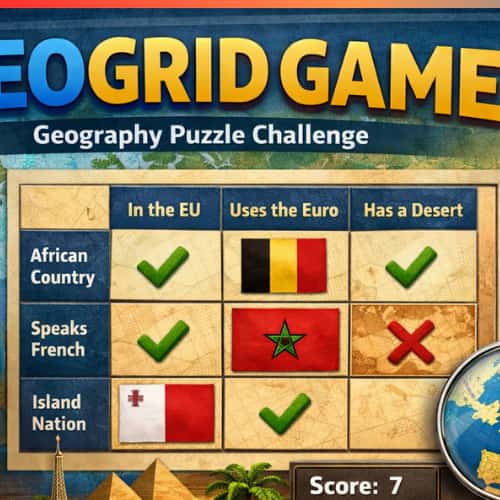
- A grid with rows and columns appears
- Each row defines one geographic condition
- Each column defines another geographic condition
- The intersection cell requires an answer satisfying both conditions
For example, a row may require African countries and a column may require French-speaking nations. The correct cell answer must satisfy both.
No timers push the player. Progress depends on accuracy and deduction.
Grid Rules and Restrictions
Geogrid Game applies strict rules that shape gameplay discipline.
- One answer per cell only
- Repeating the same country or city across cells stays blocked
- Some grids restrict answers by population size or political status
- Invalid answers lock the cell permanently
These constraints push careful decision-making. Random guessing reduces success rates rapidly.
Categories Used Inside Grids
The game rotates through multiple geography domains. This variation keeps each session fresh.
Common category sets
- Countries and sovereign states
- Capital cities
- Rivers, deserts, and mountain ranges
- Flags and national symbols
- Border relationships
- Language distribution
- Economic or regional blocs
Each category links directly to academic geography without academic pressure.
Difficulty Progression
Difficulty rises through logic density rather than speed or penalties. Early grids rely on common geographic knowledge. Later grids narrow acceptable answers using layered constraints.
Difficulty shifts include
- Smaller eligible country pools
- Overlapping linguistic and regional filters
- Obscure border combinations
- Limited political recognition territories
This gradual shift keeps the game approachable while still challenging advanced players.
Strategy Over Guessing
Geogrid Game rewards structured reasoning.
Effective approaches
- Start with cells offering the largest answer pool
- Reserve rare countries for later cells
- Track unused regions mentally
- Avoid placing large nations too early
This logical ordering reduces grid lockouts.
Educational Value Without Classroom Feel
The game sharpens geographic recall through repetition and constraint rather than memorization drills. Players absorb relationships naturally.
Skills reinforced
- Spatial awareness
- Political geography
- Linguistic distribution
- Regional classification
- Comparative geography
Learning happens organically through play sessions rather than forced study.
Scoring System
Scoring emphasizes precision rather than volume.
Score factors
- Number of correct cells
- Unused hints
- Error count
- Grid completion rate
Some versions also track rarity scores, rewarding less common but valid answers.
Hint Mechanics
Hints exist but remain limited.
- Hints reveal eligible answer pools
- Overuse lowers final score
- Some daily grids disable hints entirely
This balance preserves challenge while offering guidance to newer players.
Daily Challenge Mode
Daily grids create a shared experience across the player base. Everyone faces the same puzzle on that day.
Daily mode traits
- One attempt per day
- Identical grid for all players
- Shareable results
- No retries
This structure encourages comparison without direct competition.
| Feature | Geogrid Game | Quiz-style Geography Games |
|---|---|---|
| Answer format | Grid logic | Multiple choice |
| Guess tolerance | Very low | Moderate |
| Replay variety | High | Medium |
| Skill focus | Deduction + recall | Recall only |
| Error penalty | Strong | Light |
The grid system pushes deeper reasoning than standard quiz formats.
Platform Availability
Geogrid Game works smoothly across modern devices.
- Desktop browsers
- Tablets
- Mobile browsers
No installation required in most versions, reducing entry friction.
Accessibility and Interface
The interface remains clean and distraction-free.
- High contrast grid layout
- Minimal animations
- Clear category labels
- Keyboard input support
This design supports long play sessions without fatigue.
Social Sharing Element
Players share grid outcomes using visual summaries rather than raw answers.
- Colored grids show success patterns
- No spoilers included
- Platform-friendly formatting
This design keeps competitive spirit friendly.
Wrong Actions Players Make
Even skilled geography fans face traps.
Frequent errors
- Using famous countries too early
- Ignoring regional overlaps
- Forgetting language diversity
- Misjudging political status
Avoiding these improves completion rates quickly.
Skill Development Over Time
Repeated play sharpens pattern recognition.
- Faster elimination of invalid options
- Improved regional grouping
- Better recall of minor nations
Progress feels gradual and measurable.
Educational Use Cases
Teachers and learners use the game as a reinforcement tool.
Applications
- Classroom warm-ups
- Geography clubs
- Self-study practice
- Competitive learning sessions
The grid model supports group discussion naturally.
Updates and Grid Rotation
Content rotation prevents stagnation.
- New category mixes
- Seasonal themes
- Region-focused grids
This rotation keeps long-term players engaged.
Data and Answer Validation
All answers pass through geographic databases.
- Official country lists
- Language references
- Border records
This validation maintains consistency and fairness.
Player Community Behavior
The community focuses on strategy sharing rather than answer leaks.
- Grid discussion threads
- Rarity score comparisons
- Educational debates
This culture supports learning through discussion.
Time Commitment
Each grid requires focused attention but no long sessions.
- Average completion: 5–10 minutes
- Daily play fits busy schedules
Short sessions maintain mental freshness.
Who Benefits Most From Playing
The game suits a wide audience.
- Students sharpening geography
- Trivia fans
- Puzzle enthusiasts
- Educators seeking engagement
No prior expertise required.
Long-Term Engagement Factors
Sustained interest comes from:
- Rotating logic patterns
- Daily shared challenges
- Score improvement tracking
As an educational puzzle, Geogrid Game transforms geography into a logic-driven grid challenge that values accuracy, reasoning, and geographic awareness. Its structured format, low tolerance for error, and rotating challenges make it a rewarding mental exercise rather than a guessing contest. Players gain stronger geographic intuition naturally through repeated play, making each grid both a puzzle and a learning opportunity.